Showing posts with label C3B-Nuclear. Show all posts

Friday, December 2, 2016

Nuclear Project Presentation

Goal:
Complete and present infographics.

Agenda:
Finish Infographics
Present Infographics

Finish Infographics
You have 20 minutes to put the finishing touches on your infographic. When you are finished turn them in on Haiku. 

Present Infographics

  1. Download the peer review form by downloading the document from the Haiku assignment or this link and opening in Google Docs. 
  2. Presentations will be done as a gallery walk. Have your infographic open and on display for others to view.
  3. You are required to peer review at least 5 other infographics. Your reviews are part of your grade and will be graded on how well they provide constructive critique. 

Thursday, December 1, 2016

Nuclear Project Last Day

Goal:
Complete your infographic. 

Agenda:
Warmup
Infographic Structure
Work Time

Warmup
On whiteboards answer the following with your group:
What information do I need to know to answer the question: Is radiation dangerous?

Infographic Structure
Help Mrs. Wallace come up with a format for her infographic "Is Radiation Dangerous?"

Work TIme
Complete your infographic on your iPad. You can use any one of the following apps:
Once you are finished, turn in your completed infographic to Haiku. They will be presented tomorrow!


Wednesday, November 30, 2016

Nuclear Project Day 2

Goal:
Have a draft of your infographic completed with all of the necessary components.

Agenda:
Warmup
Radiation Overview
Data Visualization and Drafting
Self-Assess

Warmup:
What type of nuclear reaction does your topic fall under? Write it on the appropriate window with dry erase markers.

Radiation Overview:
Watch this video and consider the question: What type of radiation is involved with your topic?


Data Visualization and Draft
One important piece of your infographic is creating a model showing the scale of energy released in your reaction. Infographics often use creative graphs and charts to represent data.
  1. How can you creatively show how much energy is released by your reaction?
  2. Create a draft of your infographic. Refer back to the types of infographics to choose which type or types is right for your question. 
Self-Assess
Check the nuclear project guide. Does your draft have all the elements needed? Does your draft answer your research question?

Tuesday, November 29, 2016

Nuclear Project Day 1

Goal:
Write an essential questions to drive exploration of a phenomenon.
Use reliable web resources to answer questions about a phenomenon.

Agenda:
Warmup
get REAL
Choose Project Topic
Research
Exit Ticket

Warmup
Go here and find a current event science article to read and share with the class.

get REAL
Discuss: What strategies do you use to make sure the website you are using is reliable?
Review this infographic. Use it to evaluate whether you have a good web resource or not.

Choose Project Topic
For the next 3 days you will be researching a topic related to nuclear reactions in your life. You will be creating an infographic to educate the public about your topic and address misconceptions and misinformation about nuclear reactions. You can view the project guidelines here. 

  1. Pick a partner. Choose wisely.
  2. Decide on a nuclear topic you want to explore further. First come first served. 
  3. Come up with a question you would like to explore related to your topic.
  4. In your science journal find and record at least 3 reliable websites with information that can help you answer your question. 
  5. Write a 5 sentence summary of each article you found in your science journal. 
Exit Ticket
Fill out this Google Form individually.


Monday, November 14, 2016

Nuclear Change Differentiation

Goal:
Use models to describe fission, fusion, and nuclear decay.

Agenda:
Warmup
Quizlet Live
Nuclear Change Differentiation
Card Sort
Study Time

Warmup:
Create a new journal entry entitled "Fusion." Answer the following questions:
  1. Describe a fusion reaction. What happens? How does the nucleus change?
  2. How is fusion different than fission or decay?
  3. Why can fusion only be sustained in stars?
Quizlet Live
Go to quizlet.live

Nuclear Change Differentiation
Complete this graphic organizer in Notability.

Card Sort
Grab a whiteboard and divide it into 4 sections. Label each section alpha, beta, fission, or fusion. Sort the cards into the appropriate section. 

Study Time
Prepare for Wednesday's test by:

Thursday, November 10, 2016

Nuclear Fusion

Goal:
Gather evidence for how stars produce new chemical elements.

Agenda:
Warmup
Video
Storyboard

Warmup
In your journal entry from yesterday, write an argument in the form of a CER paragraph answering the question: Is alpha decay a form of nuclear fission?

Video
We need to answer the question: Where do all of the elements on Earth come from? Use this video to gather evidence to answer that question. 


Storyboard
Work with a partner and create a storyboard for how stars form elements. Make sure your storyboard addresses the following questions:
Of all the changes, why nuclear fusion? Of all the places, why stars?

Wednesday, November 9, 2016

Nuclear Fission

Goal:
Use models to compare and contrast fission and alpha decay in terms of how the nucleus changes.

Agenda:
Warmup
Fission Simulation
Stop Motion Video

Warmup
Socrative Quiz

Fission Simulation
Create a new journal entry entitled "Fission." I will show you the fission simulation. As we watch fission I would like you to write a description of what happens before a nuclear fission reaction. Use these questions to guide your description:

  1. What are the particles BEFORE the reaction? How many are there?
  2. What are the particles AFTER the reaction? How many are there?
Stop Motion Video
You will work with a partner for this. One of you will download Stop Motion Studio if you don't have it already. Create a stop motion video modeling either alpha decay or nuclear fission. Try to finish by the end of the class period. 

Tuesday, November 8, 2016

Nuclear Equations

Goal:
Use nuclear equations as a model to describe how the nucleus changes in alpha and beta decay.

Agenda:

Warmup - Pop Quiz
Notes
Practice
Exit Slip

Warmup
Get out a sheet of paper and answer the following questions:
  1. What makes atoms radioactive? Describe this in terms of protons, neutrons, and stability. 
  2. How do alpha and beta decay change the nucleus?
  3. How do alpha and beta decay make the nucleus more stable?
Notes


Practice
Open this document in Notability and answer the questions. 

Monday, November 7, 2016

Stability of Atoms

Goal:Use models to describe what makes an atom radioactive in terms of stability, protons, and neutrons.

Agenda:
Warmup
Isotopes Phet
Stability Chart 
Exit Slip


Warmup
Work with your team on whiteboards. 
Study the following models of alpha decay. For each example, write down the number of protons and neutrons for each atom before and after the change. What is the pattern in how the nucleus changes for alpha decay?

Study the following models of beta decay. For each example, write down the number of protons and neutrons for each atom before and after the change. What is the pattern in how the nucleus changes for beta decay?

Isotopes Phet
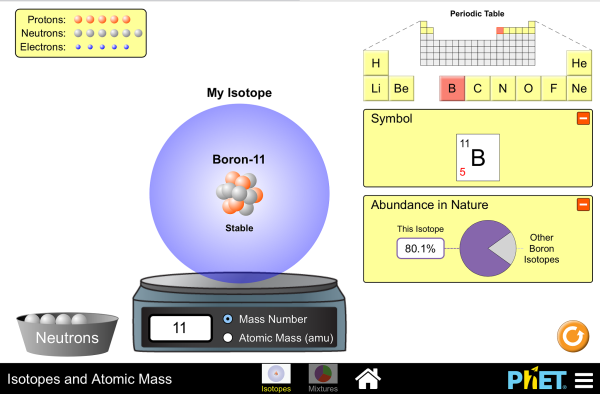
Using the Phet simulation, try to answer the question: What makes an atom unstable?
Isotopes and Atomic Mass
Click to Run

Stability Chart
In your science journal, create a new entry entitled "Stability Chart." Copy and paste the chart below into your journal and use it to answer the questions.


A: Write down 3 observations describing the chart.
B: What does this graph tell us about the stability of atoms?
C: Use the graph to predict if the following atoms are stable. State WHY you think they are unstable based on the graph.
  1. An atom with 20 protons and 20 neutrons.
  2. An atom with 100 protons and 100 neutrons.
  3. An atom with 80 protons and 120 neutrons.
  4. An atom with 60 protons and 40 neutrons.
  5. An atom with 40 protons and 80 neutrons.

D: Propose a stable atom. Write the following information about the proposed atom:
  • Element Name
  • # of Protons
  • # of Neutrons
Exit Slip
At the top of your journal entry, write a CER paragraph to answer the following question:

Why do you think atoms are radioactive?

Friday, November 4, 2016

Alpha and Beta Decay

Goal:
Identify patterns in how a nucleus changes in alpha or beta decay.

Agenda:
Finish ACT
Teamwork Rubric
Warmup
Phet Simulations
Exit Ticket

Finish ACT
Periods 1 and 2 need to finish the ACT. You have 10 minutes. Do your best.

Teamwork Rubric
Choose a facilitator, scribe, and timer. Follow the provided protocol for teamwork evaluation.

Warmup
On the provided paper, write down 1 question or wondering you have about radiation based on what you learned yesterday.

Phet Simulations

  1. Create a new journal entry entitled "Alpha and Beta Decay." 
  2. Copy these questions into your science journal.
  3. Using a computer, answer the questions in your journal by using the Phet simulations
    1. Alpha Decay
    2. Beta Decay
Exit Ticket
Complete the exit ticket. 

Thursday, November 3, 2016

Radiation and ACT

Goal: 
Learn a bit about radiation all around you.
Show how well you understand data analysis, experimental design, and scientific arguments.

Agenda:
Warmup
Personal Radiation Dose
ACT Test

Warmup
Kahoot!

Personal Radiation Dose
Complete this worksheet to estimate your annual personal radiation dose. 

ACT Test
This is a science diagnostic. All DLA scholars will be taking this test. You do not need to know science, you need to know experiments and analysis. You must answer every question.