Goal:
Finish the Sand/Soil short report and prepare for the energy test tomorrow.
Useful Links for Short Report:
Short Report Outline + Sentence Starters
Useful Links for Energy Test:
Energy Quizlet
Haiku Practice Test
Study Guide (on paper)
Showing posts with label C2-Energy. Show all posts
Showing posts with label C2-Energy. Show all posts
Thursday, October 6, 2016

Wednesday, October 5, 2016
Sand/Soil Lab Wrap Up
Goal:
Complete the short report for the Sand/Soil lab.
**Useful Materials for Today**
Your Sand/Soil Short Report (Google Docs)
The Short Report Summary/Outline
Agenda:
Warmup
Make Excel Table
Class Discussion
Group Outline
Write
Warmup
Using the data you gathered from yesterday's lab, calculate ∆T for the sand and the soil. Record this information in the observations section of your short report Google Doc.
Make Excel Table
Using the Excel app, make a data table using the guidelines in the short report manual. When you have finished, copy and paste this into your short report Google Doc.
Class Discussion
Vote: which would be better to build your shelter, sand or dirt?
Make a list of possible errors with the experimental design and setup.
Group Outline
On whiteboards, make an outline of the CER and PE paragraphs for this report. Remember, outlines should be BULLET POINTS, not complete sentences.
Write
Silently complete the CER and PE in your lab report. Use the outline you created with your group and the sentence starters provided.
Complete the short report for the Sand/Soil lab.
**Useful Materials for Today**
Your Sand/Soil Short Report (Google Docs)
The Short Report Summary/Outline
Agenda:
Warmup
Make Excel Table
Class Discussion
Group Outline
Write
Warmup
Using the data you gathered from yesterday's lab, calculate ∆T for the sand and the soil. Record this information in the observations section of your short report Google Doc.
Make Excel Table
Using the Excel app, make a data table using the guidelines in the short report manual. When you have finished, copy and paste this into your short report Google Doc.
Class Discussion
Vote: which would be better to build your shelter, sand or dirt?
Make a list of possible errors with the experimental design and setup.
Group Outline
On whiteboards, make an outline of the CER and PE paragraphs for this report. Remember, outlines should be BULLET POINTS, not complete sentences.
Write
Silently complete the CER and PE in your lab report. Use the outline you created with your group and the sentence starters provided.
Tuesday, October 4, 2016
Sand/Soil Lab
Goal:
Gather data to make a claim about which substance has the higher heat capacity.
Agenda:
Warmup
Draw Flowgram
Write Procedures
Lab Time!
Make a Claim
Warmup
Re-Do Socrative. Login to Socrative and take the Sand/Soil pre-lab quiz again. This time you will take the quiz on your own.
Draw Flowgram
Using your experimental design plan from "The How" you completed yesterday, draw a flowgram of what your lab procedure will be.
Write Procedures
Open your Sand/Soil Short Report Google Doc. Write step-by-step procedures in the "Procedures" section for the lab using your flowgram as a guide. Use the following guidelines from the rubric:
Lab Time!
Following your procedures, collect data on the heat capacity of sand and soil. Record observations in the "Observations" section of your Sand/Soil Short Report Google Doc. Use the following guidelines for your observations:
Make a Claim
Complete the exit ticket I hand out to you.
Gather data to make a claim about which substance has the higher heat capacity.
Agenda:
Warmup
Draw Flowgram
Write Procedures
Lab Time!
Make a Claim
Warmup
Re-Do Socrative. Login to Socrative and take the Sand/Soil pre-lab quiz again. This time you will take the quiz on your own.
Draw Flowgram
Using your experimental design plan from "The How" you completed yesterday, draw a flowgram of what your lab procedure will be.
Write Procedures
Open your Sand/Soil Short Report Google Doc. Write step-by-step procedures in the "Procedures" section for the lab using your flowgram as a guide. Use the following guidelines from the rubric:
- Procedural steps are numbered and easy to follow.
- Procedures include materials and quantities used for each step in the experiment.
Lab Time!
Following your procedures, collect data on the heat capacity of sand and soil. Record observations in the "Observations" section of your Sand/Soil Short Report Google Doc. Use the following guidelines for your observations:
- Observations are taken at each procedural step.
- Observations include qualitative and quantitative data when applicable.
Make a Claim
Complete the exit ticket I hand out to you.
Monday, October 3, 2016
Sand/Soil Plan
Goal:
Complete "The How" in your Sand/Soil Short Report and draw a flowgram of the procedure you will use tomorrow.
Agenda:
Warmup
Socrative
The How
Flowgram
Re-Do Socrative
Warmup
Work on this on whiteboards with your group.
Come up with 3 different ways to find the heat capacity of sand. Draw how you would do this in the lab.
Socrative
Login to Socrative. This quiz will be taken together as a class.
The How
Open up your Sand/Soil Short Report in Google Docs. Work with your table groups to complete the experimental design temple under "The How"
Flowgram
On whiteboards, draw a flowgram of the procedure you came up with in "The How." Remember, your flowgram should have a drawing for each step as well as tools and measurements labeled.
Complete "The How" in your Sand/Soil Short Report and draw a flowgram of the procedure you will use tomorrow.
Agenda:
Warmup
Socrative
The How
Flowgram
Re-Do Socrative
Warmup
Work on this on whiteboards with your group.
Come up with 3 different ways to find the heat capacity of sand. Draw how you would do this in the lab.
Socrative
Login to Socrative. This quiz will be taken together as a class.
The How
Open up your Sand/Soil Short Report in Google Docs. Work with your table groups to complete the experimental design temple under "The How"
Flowgram
On whiteboards, draw a flowgram of the procedure you came up with in "The How." Remember, your flowgram should have a drawing for each step as well as tools and measurements labeled.
Thursday, September 29, 2016
Understanding the Sand/Soil Lab
Goal:
Write the Title, Research Question, and Background for the Sand/Soil short report.
Homework:
Finish the Background (Why/What only)
Agenda:
Warmup
Writing Across the Disciplines
Lecture/Discussion
Outline
Write
Write the Title, Research Question, and Background for the Sand/Soil short report.
Homework:
Finish the Background (Why/What only)
Agenda:
Warmup
Writing Across the Disciplines
Lecture/Discussion
Outline
Write
Warmup
What is the purpose of writing an introduction?
Writing Across the Disciplines
What is the purpose of writing an introduction?
Writing Across the Disciplines
What does an introduction look like in Ms. Stillman's class? What is the purpose of the introduction?How does this translate to writing in science?
Lecture/Discussion
We need to make sense of the sand/soil lab. Do we want a substance with high or low heat capacity? How can we measure this?
Outline
Work with your table groups to outline the introductory paragraph (The Why and The What) of your short report. Use the whiteboards and refer to this handout for guidelines. DO NOT WRITE, just outline the ideas.
Write
In the google doc I shared with you, complete The Why and The What paragraph of the background.
Wednesday, September 28, 2016
It's so hot...
Goal:
Design and conduct a calorimetry experiment to compare the heat capacity of different substances.
Agenda:
Warmup
Watch - The Midnight Sun
Plan
Experiment
Warmup
"Solar energy is just another form of nuclear energy."
Do you agree or disagree with this statement? Justify your reasoning.
Watch - The Midnight Sun
We will watch part of this episode of the Twilight Zone and consider our impending doom.
Plan
On whiteboards, work with your group to plan how you can answer the question, "What makes the best shelter, sand or soil?" Think about your variables in terms of Q=mC∆T.
Experiment
Carry out your plan using the provided materials.
Design and conduct a calorimetry experiment to compare the heat capacity of different substances.
Agenda:
Warmup
Watch - The Midnight Sun
Plan
Experiment
Warmup
"Solar energy is just another form of nuclear energy."
Do you agree or disagree with this statement? Justify your reasoning.
Watch - The Midnight Sun
We will watch part of this episode of the Twilight Zone and consider our impending doom.
Plan
On whiteboards, work with your group to plan how you can answer the question, "What makes the best shelter, sand or soil?" Think about your variables in terms of Q=mC∆T.
Experiment
Carry out your plan using the provided materials.
Tuesday, September 27, 2016
Review Calculations + Academic Recovery
Goal:
Set goals to be the best by clearing NMs and preparing for competencies.
Homework:
Quizlet Flashcards and Haiku Practice
Agenda:
Review Calculations
Error Discussion
AR Day Goals
Academic Recovery
Review Calculations
I will pass back your calculations from yesterday. Many of you only calculated the heat for ONE of the two foods. Please finish. I will work with people that need extra help.
Once you have finished the calculations, GO VOTE for which food to stash on the front whiteboard.
Error Discussion
A few groups came to a different conclusion than the majority. What might have happened in these experiments? Make a list of possible errors with your group.
AR Day Goals
On the sheet of paper I pass out to you, write 1 goal for this class period (Clear my ___________ NM in humanities. Prepare for _________________ competency.)
Write 3 specific action items you will do to reach this goal. Don't just write "Study." How will you study?
Academic Recovery
If you have no NMs and would like to prepare for your Biochem competency next Friday, get a 4 on the Haiku practice test and practice with the quizlet flashcards.
Set goals to be the best by clearing NMs and preparing for competencies.
Homework:
Quizlet Flashcards and Haiku Practice
Agenda:
Review Calculations
Error Discussion
AR Day Goals
Academic Recovery
Review Calculations
I will pass back your calculations from yesterday. Many of you only calculated the heat for ONE of the two foods. Please finish. I will work with people that need extra help.
Once you have finished the calculations, GO VOTE for which food to stash on the front whiteboard.
Error Discussion
A few groups came to a different conclusion than the majority. What might have happened in these experiments? Make a list of possible errors with your group.
AR Day Goals
On the sheet of paper I pass out to you, write 1 goal for this class period (Clear my ___________ NM in humanities. Prepare for _________________ competency.)
Write 3 specific action items you will do to reach this goal. Don't just write "Study." How will you study?
Academic Recovery
If you have no NMs and would like to prepare for your Biochem competency next Friday, get a 4 on the Haiku practice test and practice with the quizlet flashcards.
Monday, September 26, 2016
Food Lab
Goal:
Collect calorimetry data and complete calorimetry calculations to determine which food contains the most chemical energy.
Agenda:
Poll
Collect Lab Data
Tables
Calculations
Poll
In this lab we will be comparing almonds to Cheetos. Which of the foods do you think will have the most chemical energy?
Collect Lab Data
Collect calorimetry data and complete calorimetry calculations to determine which food contains the most chemical energy.
Agenda:
Poll
Collect Lab Data
Tables
Calculations
Poll
In this lab we will be comparing almonds to Cheetos. Which of the foods do you think will have the most chemical energy?
Collect Lab Data
- Create a new entry in your science journal entitled "Food Lab."
- Copy the procedures and observations table from the Period __ - Food Lab Procedure and paste it into your science journal.
- Carry out the lab procedure as we wrote it on Friday and record all measurements in the observation section in your science journal.
Tables
Using excel, create the following data table and enter the measurements from your experiment. Copy and paste the data
table into your science journal once it is completed.
FOOD SAMPLE
|
INITIAL MASS (mi) g
|
FINAL MASS (mf) g
|
INITIAL T (Ti) oC
of water
|
FINAL T (Tf) oC
of water
|
MASS BURNED
of food
|
ΔT
oC
of water
| |
Food 1
| |||||||
Food 2
| |||||||
Food 3
|
Calculations
Complete the "Calorimetry of Food Calculations" sheet to make your claim. You can write on the back if you need more space. Turn these in to Mr. Nash.
Friday, September 23, 2016
Food Calorimetry Pre-Lab
Goal:
Design a calorimetry experiment to calculate the amount of energy in different foods.
Homework:
Practice Quizlet Flashcards
Agenda:
Warmup - Socrative Quiz
Demo + Discussion
Read
Design a Procedure - Flowgram
Class Write - Protocol
Warmup - Socrative Quiz
Login to Socrative and take the quiz
Demo + Discussion
Demo: Jug-O-Doom (again, because it's fun)
Discuss:
Design a calorimetry experiment to calculate the amount of energy in different foods.
Homework:
Practice Quizlet Flashcards
Agenda:
Warmup - Socrative Quiz
Demo + Discussion
Read
Design a Procedure - Flowgram
Class Write - Protocol
Warmup - Socrative Quiz
Login to Socrative and take the quiz
Demo + Discussion
Demo: Jug-O-Doom (again, because it's fun)
Discuss:
- What forms of energy are represented in this demo?
- Using the principles of heat transfer, how might we calculate the amount of chemical energy that was released in the demo?
Read
Read the background for Monday's lab to get an idea of how scientists use calorimetry experiments to measure the amount of energy in a substance.
Design a Procedure - Flowgram
On whiteboards, draw a flowgram to show how you can use calorimetry to find out how much energy is in different foods. Be specific, we will use these to write a procedure.
Class Write - Protocol
Choose a scribe. Get in a circle. We are going to use what you came up with on your whiteboards to write a step-by-step protocol for Monday's lab.
Thursday, September 22, 2016
Calorimetry
Goal:
Master calorimetry calculations (Q=mC∆T).
Homework:
Finish Calorimetry Practice
Practice Quizlet Flashcards
Agenda:
Discussion
Notes
Practice
Exit Ticket Quiz
Discussion:
What were the factors that affect heat transfer? How did they affect heat transfer?
Notes:
I will go over these slides. You may take notes in whatever fashion works best for you.
Practice:
Open this worksheet in notability and complete it using your new knowledge. Check your answers with the answer key here.
Exit Ticket Quiz
I will pass out this 1 question quiz to you. Complete it and turn it in as you walk out the door.
Master calorimetry calculations (Q=mC∆T).
Homework:
Finish Calorimetry Practice
Practice Quizlet Flashcards
Agenda:
Discussion
Notes
Practice
Exit Ticket Quiz
Discussion:
What were the factors that affect heat transfer? How did they affect heat transfer?
Notes:
I will go over these slides. You may take notes in whatever fashion works best for you.
Practice:
Open this worksheet in notability and complete it using your new knowledge. Check your answers with the answer key here.
Exit Ticket Quiz
I will pass out this 1 question quiz to you. Complete it and turn it in as you walk out the door.
Wednesday, September 21, 2016
Heat Transfers
Goal:
Conduct an investigation to identify how different variables affect the amount of heat transferred between objects.
Agenda:
Warmup
Demo + Discussion
Experiment
Exit Ticket
Warmup
Log into Socrative and take the quiz on yesterday's content.
Demo + Discussion
One balloon is full of carbon dioxide. The other balloon is full of water. If I hold a flame under them...
What is the direction of heat flow?
What is happening to the molecules inside the balloons?
Experiment
In this experiment we are going to make hypotheses about things that can change the amount of heat absorbed from water.
Exit Ticket
Log into socrative.
Teacher's Question:
What are the three variables that affect the amount of heat transferred between objects?
Conduct an investigation to identify how different variables affect the amount of heat transferred between objects.
Agenda:
Warmup
Demo + Discussion
Experiment
Exit Ticket
Warmup
Log into Socrative and take the quiz on yesterday's content.
Demo + Discussion
One balloon is full of carbon dioxide. The other balloon is full of water. If I hold a flame under them...
What is the direction of heat flow?
What is happening to the molecules inside the balloons?
Experiment
In this experiment we are going to make hypotheses about things that can change the amount of heat absorbed from water.
- How can you measure the amount of heat transferred between substances?
- Make a list of things you PREDICT will change the amount of heat transferred.
- Design controlled experiments to test these predictions.
- Record your observations in your journal (Title: Ice Experiment). Here are some suggested sentence stems:
- When we increased _________________, the temperature <increased or decreased> from _____ degrees Celsius to _____ degrees Celsius, a difference of _____ degrees.
- When we changed _________________, the temperature <increased or decreased> from _____ degrees Celsius to _____ degrees Celsius, a difference of _____ degrees.
- Make sense: what variables affected the heat transfer? Did this match your prediction?
Exit Ticket
Log into socrative.
Teacher's Question:
What are the three variables that affect the amount of heat transferred between objects?
Tuesday, September 20, 2016
How does heat flow?
Goal:
Create a mini poster showing your understanding of heat flow.
Agenda:
Socrative Quiz (Warmup)
Notes/Practice
Mini Poster
Socrative Quiz (Warmup)
Log in to Socrative and take the quiz
Period 1: WALLACEP1
Period 2: WALLACEP2
Period 4: WALLACEP4
Notes/PracticeCreate a new journal entry entitled "Heat Flow." Read through these slides to learn about and take notes on heat flow. Complete the practice in the slides.
Mini Poster
Look at the example poster on the last slide. Get a sheet of paper and create your own poster drawing, describing, and graphing heat flow for your own situation. You can use scenarios from movies, cooking, cars, anything where heat flows from one object to another.
If you finish early...
Practice with the new quizlet flashcards.
Create a mini poster showing your understanding of heat flow.
Agenda:
Socrative Quiz (Warmup)
Notes/Practice
Mini Poster
Socrative Quiz (Warmup)
Log in to Socrative and take the quiz
Period 1: WALLACEP1
Period 2: WALLACEP2
Period 4: WALLACEP4
Notes/PracticeCreate a new journal entry entitled "Heat Flow." Read through these slides to learn about and take notes on heat flow. Complete the practice in the slides.
Mini Poster
Look at the example poster on the last slide. Get a sheet of paper and create your own poster drawing, describing, and graphing heat flow for your own situation. You can use scenarios from movies, cooking, cars, anything where heat flows from one object to another.
If you finish early...
Practice with the new quizlet flashcards.
Monday, September 19, 2016
What is heat/cold?
Goal:
Get a basic foundation on heat.
Agenda:
Warmup
Discussion
Blendspace Lesson
Get a basic foundation on heat.
Agenda:
Warmup
Discussion
Blendspace Lesson
Journal Entry
Socrative Quiz
Warmup
With your elbow partner, discuss: What forms of energy do we get from food?
Discussion
Log into Socrative and answer the question. You will be asked to share your reasoning with the class.
Blendspace Lesson
Sign up for Blendspace with your Google Account. Use class code "luke." Follow the blendspace lesson found here. Be sure to take notes. This is your foundation for the rest of the unit.
Journal Entry
Create a new journal entry entitled "Heat thought experiments." Copy the questions below into your journal and use your new knowledge to answer the questions.
Questions
Socrative Quiz
Warmup
With your elbow partner, discuss: What forms of energy do we get from food?
Discussion
Log into Socrative and answer the question. You will be asked to share your reasoning with the class.
Blendspace Lesson
Sign up for Blendspace with your Google Account. Use class code "luke." Follow the blendspace lesson found here. Be sure to take notes. This is your foundation for the rest of the unit.
Journal Entry
Create a new journal entry entitled "Heat thought experiments." Copy the questions below into your journal and use your new knowledge to answer the questions.
Questions
- Use kinetic molecular theory to explain what is happening to the water molecules in an ice cube as it melts. (Hint: Are they moving faster, slower, or not changing in speed.) You must explain your reasoning.
- What is the difference between heat and temperature?
- How does heat flow?
- You have two pans made of the same metal, iron. One is heavier than the other. You heat both to the same temperature. Which one will cool down faster?
- On a winter morning, you open the door to your house. You feel a cold wind strike you as soon as the door opens. What is happening?
- When water freezes, explain what happens to the water molecules?
- When water boils, explain what happens to the water molecules?
- When ice melts, explain what happens to the water molecules?
Socrative Quiz
Log in to Socrative and take the quiz
Period 1: WALLACEP1
Period 2: WALLACEP2
Period 1: WALLACEP1
Period 2: WALLACEP2
Period 4: WALLACEP4
My Question: On a winter morning, you open the door to your house. You feel a cold wind strike you as soon as the door opens. What is happening?
My Question: On a winter morning, you open the door to your house. You feel a cold wind strike you as soon as the door opens. What is happening?
Friday, September 16, 2016
Forms of Energy
Goal:
Describe and categorize different forms of energy (i.e. chemical, electrical, electromagnetic, thermal, mechanical, and nuclear) and use this knowledge to explain how energy is neither created nor destroyed.
Agenda:
Warmup
Energy Poster
Phet: Energy Forms and Changes
Quizlet
Socrative Quiz
Warmup
Study this collage. What do all the images have in common?

Energy Poster
Create a new journal entry entitled "Energy Definitions." Silently read this poster. Identify the two main points the poster makes and record them in your journal.

Phet: Energy Forms and Changes
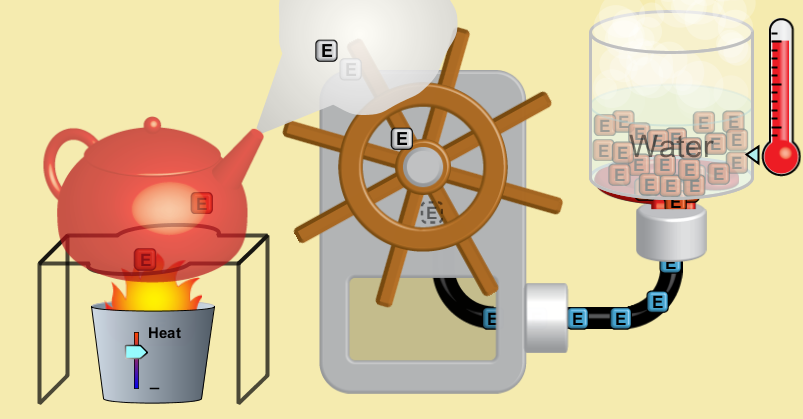 Thermal energy from flame → heating water in teapot → steam from teapot converts heat energy to mechanical energy to turn the wheel → mechanical energy from turning of the wheel converts to electrical energy → electrical energy converts to thermal energy to heat the water
Quizlet
Once you finish with the Phet simulation, use the Quizlet flashcards to study and memorize the different forms of energy.
Socrative Quiz
Log in to Socrative and take the quiz
Period 1: WALLACEP1
Period 2: WALLACEP2
Describe and categorize different forms of energy (i.e. chemical, electrical, electromagnetic, thermal, mechanical, and nuclear) and use this knowledge to explain how energy is neither created nor destroyed.
Agenda:
Warmup
Energy Poster
Phet: Energy Forms and Changes
Quizlet
Socrative Quiz
Warmup
Study this collage. What do all the images have in common?

Energy Poster
Create a new journal entry entitled "Energy Definitions." Silently read this poster. Identify the two main points the poster makes and record them in your journal.

Phet: Energy Forms and Changes
From the PhET’s Simulations site, Run now! or Download “Energy Forms and Changes” simulation (see https://phet.colorado.edu/en/simulation/energy-forms-and-changes ). Click the “Energy System” tab on the left and, on the right, tick the “Energy Symbols” indicator.

From the three panels at the bottom of the simulation choose devices and construct a working Energy System. Construct at least three working energy systems.
For each system you make, identify the different forms that the energy goes through at each step and write it in your journal.
For example:
Quizlet
Once you finish with the Phet simulation, use the Quizlet flashcards to study and memorize the different forms of energy.
Socrative Quiz
Log in to Socrative and take the quiz
Period 1: WALLACEP1
Period 2: WALLACEP2
Period 4: WALLACEP4
Thursday, September 15, 2016
APOCALYPSE NOW
Goal:
Determine what you will need to do to survive the inevitable heat death of Earth.
Agenda:
Warmup
Earth's Temperature Timeline
Obama Interview
Survival Guide
Warmup
Discuss: Why do we look at things close up and far away?
Earth's Temperature Timeline
Take a look at this XKCD comic. What are 3 things you observe close up? 3 things you observe far away?
Obama Interview
Watch this interview with President Obama on climate change and consider the long term implications of climate change for society and life on Earth.
Survival Guide
On whiteboards with your group, make a list of things you will need to know and do to survive a climate change apocalypse.
Determine what you will need to do to survive the inevitable heat death of Earth.
Agenda:
Warmup
Earth's Temperature Timeline
Obama Interview
Survival Guide
Warmup
Discuss: Why do we look at things close up and far away?
Earth's Temperature Timeline
Take a look at this XKCD comic. What are 3 things you observe close up? 3 things you observe far away?
Obama Interview
Watch this interview with President Obama on climate change and consider the long term implications of climate change for society and life on Earth.
Survival Guide
On whiteboards with your group, make a list of things you will need to know and do to survive a climate change apocalypse.
Wednesday, September 14, 2016
Evidence of Climate Change
Goal:
Read and interpret scientific articles to gather evidence.
Agenda
Warmup
John Oliver - Climate Change
Read
Share
Warmup
Watch this video and consider the question: Why can't life exist everywhere?
Share
Write down at least three pieces of evidence from your article on separate post it notes. Trade post its with three different people.
Read and interpret scientific articles to gather evidence.
Agenda
Warmup
John Oliver - Climate Change
Read
Share
Warmup
Watch this video and consider the question: Why can't life exist everywhere?
John Oliver - Climate Change
Read
Choose one of the following articles to read to find scientific evidence of climate change. Use to comment feature in Google docs to annotate and share your thoughts with your classmates.
Climate Change: How Do We Know? - Easy Read
Seven Answers to Climate Contrarian Nonsense - Average Difficulty
How Unique are Today's Temperatures - Challenging (includes annotations)
Share
Write down at least three pieces of evidence from your article on separate post it notes. Trade post its with three different people.
Tuesday, September 13, 2016
Dinopocalypse!
Goal: Describe
what it might be like for humans to live in temperature extremes. Consider
challenges for surviving in extreme heat and cold.
Agenda:
Discussion
Radiolab
Journal
Discussion
What do humans need to
survive?
Radiolab
Get a whiteboard and a marker. Watch the Dinopocalypse Radiolab
As you watch and listen, illustrate what happened to earth when the meteor
struck on your whiteboards.
Journal
Create a new entry in your science journal
entitled Extreme Temperatures. Take a photo of your whiteboard and
add it to the journal entry. Now imagine what it would be like to
experience an extreme temperature (hot or cold). What challenges would you face and what will you need to do to survive? Record your responses
in your journal.
Subscribe to:
Posts (Atom)